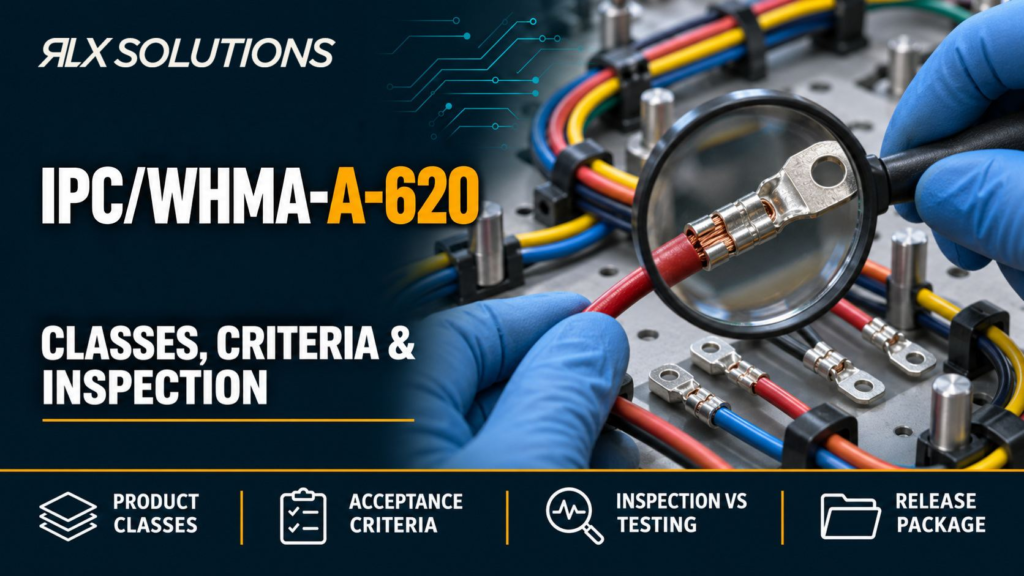
IPC/WHMA-A-620 is the acceptance standard for cable and wire harness workmanship, covering preparation, crimping, soldered terminations, connectorization, shielding, marking, and related assembly work. It gives engineering and procurement teams a common basis for acceptance by product class, and it is the workmanship basis RLX applies to the harnesses it builds.
RLX Solutions, a contract electronics manufacturer based in Concord (Vaughan), Ontario, produces custom harness builds inspected to A-620 workmanship criteria from customer drawings, prototype to production.
The shorthand IPC 620 commonly refers to IPC/WHMA-A-620. A project should identify the required revision so drawings, inspection instructions, and supplier procedures point to the same requirement set.
IPC 620 sets the acceptance language for cable and harness workmanship
The standard covers requirements and acceptance for cable and wire harness assemblies. It addresses the manufacturing and inspection side of the interconnect, including crimped, mechanically secured, and soldered connections.
A harness can be electrically functional and still contain workmanship that does not meet the specified acceptance criteria. Continuity does not, by itself, establish acceptable conductor preparation, crimp formation, insulation support, solder workmanship, shielding, marking, or mechanical assembly.
An acceptance criterion is the condition used to decide whether a feature is acceptable for the specified product class. A defect is a condition that fails the applicable requirement. A process indicator is a condition that may signal process variation even when the assembly is not rejected under the applicable criteria.
A-620 connects assembly practice, inspection, test, and process control to the product definition supplied by the customer.
Product classes change what counts as acceptable
The three A-620 product classes reflect different performance expectations. Class selection should come from the program requirement, drawing, or purchasing documentation. Choosing a higher class simply because it sounds safer can create a mismatch between the actual product requirement and the manufacturing controls being requested.
| Decision factor | Class 1 | Class 2 | Class 3 |
|---|---|---|---|
| General intent | General electronic products | Dedicated-service electronic products | High-performance electronic products |
| Service expectation | Function is the main requirement | Continued performance and extended service are expected | Continued performance or performance on demand is critical |
| Manufacturing implication | Acceptance criteria support the general-use requirement | Tighter control is applied where the standard differentiates the class | The strictest applicable acceptance criteria and stronger process-control expectations apply |
| Buyer action | State the class in the controlled build documentation | State the class and any customer-specific inspection or test requirements | State the class early and make process-control, inspection, test, and documentation expectations explicit |
The class does not design the harness. Conductor gauge, insulation system, connector family, pinout, branch geometry, shielding architecture, environmental requirements, and electrical performance still come from controlled product documentation. A purchase order that says only “IPC Class 3” has not fully defined the assembly.
Acceptance criteria extend from wire preparation to the finished harness
A-620 follows the workmanship features that can create an interconnect failure or an inspection dispute. Each manufacturing step can introduce a condition that affects electrical continuity, mechanical retention, insulation integrity, or later assembly.
Key areas include:
- Wire preparation. Strip operations must remove insulation without creating unacceptable conductor or insulation damage.
- Crimp terminations. The crimp must form the intended electrical and mechanical connection while supporting the conductor and insulation as required by the termination system.
- Soldered terminations. Solder workmanship is judged separately from crimp workmanship because the joining mechanism and failure modes differ.
- Insulation displacement connections. Conductor placement and termination condition must support the connection method defined by the connector system.
- Splices. The splice must meet the required mechanical and electrical workmanship criteria while maintaining the intended insulation and routing.
- Connectorization. Contact insertion, retention, orientation, hardware, and related assembly features affect whether the harness mates and remains serviceable.
- Shielding and protective coverings. Shield terminations, braid, sleeving, tubing, and other coverings must support the design intent without creating workmanship defects.
- Marking and labelling. Identification has to remain consistent with the drawing and assembly requirements.
A crimp termination is a mechanically formed electrical joint between a conductor and a contact or terminal. Its quality depends on the conductor, terminal, tooling, setup, and the resulting formed connection. This is why inspection cannot be reduced to checking whether a terminal looks attached.
Consider a hypothetical 12-conductor cable assembly with 24 crimped contacts and one soldered shield drain. A continuity test can confirm the 12 intended circuits and identify opens, shorts, or a wrong pin assignment. It cannot, by itself, prove that all 24 crimps meet the workmanship criteria or that the shield drain solder termination is acceptable. Visual and dimensional inspection answer a different question from electrical test.
Inspection and electrical testing answer different questions
Inspection asks whether the assembly was built acceptably. Electrical testing asks whether specified electrical conditions are present. A strong acceptance plan uses each for the failure mode it can detect.
For harnesses and cable assemblies, inspection can address visible or measurable workmanship at wire preparation, crimps, soldered terminations, connector assembly, shielding, covering, routing, and identification. Electrical testing can identify connection errors that visual inspection may not reveal.
A production test plan can combine continuity, opens, shorts, pin assignment, crimp pull testing, and any program-specific electrical or mechanical tests defined by the customer. The test plan should state which checks apply to every unit and which are process-verification activities.
Inspection results also need context. A rejected termination may indicate an isolated defect or a process issue affecting more than one unit. The response should preserve traceability to the applicable drawing revision, tooling setup, material lot, and test record.
A-620 does not automatically define how often every in-process or finished-product inspection must occur. The inspection plan, drawing, purchasing requirements, and supplier process controls still establish how acceptance is implemented. During supplier review, ask which revision and class are used, how the requirement reaches work instructions, and which tests are tied to the drawing.
Specify A-620 in the controlled release package
A usable manufacturing package should remove ambiguity before material reaches production. For a cable or harness build, the release package should identify the assembly itself and the workmanship basis used to inspect it.
Include, as applicable:
- Controlled assembly drawing and revision.
- Bill of materials with manufacturer part information where required.
- Connector and terminal identification.
- Wire and cable specification.
- Pinout or wiring table.
- Branch lengths, breakout locations, orientation, and mechanical dimensions.
- Applicable A-620 revision and product class.
- Customer-specific workmanship notes that supplement the standard.
- Electrical test requirements and acceptance method.
- Any program-specific mechanical, environmental, shielding, or documentation requirements.
The revision and class belong in controlled documentation. Purchasing, production, and inspection need to work from the same requirement set.
A user-supplier agreement is also important when the project requires an interpretation or condition outside the standard’s default framework. The requirement should be written into the controlled program documentation rather than left as an email assumption that never reaches the production floor.
A-620, IPC-A-610, J-STD-001 and IPC-D-620 solve different problems
These standards are related, but they are not interchangeable.
IPC/WHMA-A-620 governs requirements and acceptance for cable and wire harness assemblies. IPC-A-610 addresses acceptability of electronic assemblies such as populated circuit boards. J-STD-001 addresses requirements for soldered electrical and electronic assemblies. IPC-D-620 is the design and critical-process companion for cable and wiring harnesses.
| Document | What it governs | Where it applies in a mixed product |
|---|---|---|
| A-620 | Workmanship and acceptance of cable and harness assemblies | Crimps, splices, connectorization, shielding, marking |
| IPC-A-610 | Acceptability of completed electronic assemblies | Populated boards and board-mounted hardware |
| J-STD-001 | Requirements for producing soldered assemblies | Soldering materials, process and joint requirements |
| IPC-D-620 | Design and critical-process requirements for harnesses | Harness design decisions made before release |
A mixed electromechanical product can invoke different standards at different manufacturing stages. A control unit may contain a populated printed circuit board, a board-to-panel cable, a multi-branch harness, and soldered terminations. Each interconnect should be traceable to the document that judges it, so an inspector never applies board criteria to a crimp or harness criteria to a solder joint on the PCB.
A separate RLX article on how Class 2 and Class 3 change PCB fabrication and assembly covers that class decision on the board side. Another explains serialization, lot tracking and production records for assemblies. Those topics support the same quality system discussion, but they do not replace harness-specific A-620 acceptance criteria.
For the board side, the companion guide to acceptance criteria for populated circuit board assemblies covers workmanship rather than cable work. The guide to continuity, hi-pot and pull tests on finished harnesses covers test methods that sit beside, rather than replace, workmanship acceptance.
IPC 620 certification is different from assembly acceptance
The phrase “A-620 certification” can refer to IPC training and certification programs for people, or to formal manufacturer qualification programs. It should not be used loosely to imply that a finished harness receives an IPC certificate simply because it was built to the standard.
IPC offers role-based certification programs associated with A-620, including Certified IPC Specialist and trainer or standards-expert paths. IPC also operates manufacturer qualification programs that evaluate manufacturing processes against the standard.
Those concepts are distinct from accepting a specific assembly against its drawing, revision, class, and workmanship criteria.
Harnesses are built to IPC/WHMA-A-620 workmanship.
That wording keeps the claim precise. It says what governs the workmanship without implying a product certification that the standard does not create.
Worked comparison: the same harness can create different control requirements
Consider two hypothetical 24-circuit harnesses with the same connector pair, the same two branches, the same conductor sizes, and the same pinout.
Harness A is released as Class 2. Harness B is released as Class 3. Electrically, the assemblies can be identical. The difference is the acceptance level and the process-control expectation applied during manufacturing and inspection.
That class change can affect how production instructions are written, how inspectors judge workmanship, how process variation is handled, and what evidence the buyer expects to retain. It does not automatically change the wire gauge, connector, circuit count, or routing geometry.
Now add one customer-specific requirement to Harness B: every finished unit must receive continuity verification and a program-defined insulation test, with the result associated to the unit identifier. That requirement comes from the customer program, not from treating Class 3 as a substitute for the drawing.
The comparison shows why class and testing should be specified separately. Class defines the workmanship acceptance level. The drawing and test specification define what the harness must do and what evidence must be produced.
Request a Line-Item Cable Assembly Quote
Send your harness drawing, wire list and connector part numbers. RLX Solutions builds custom wire harnesses and cable assemblies to customer drawings, from low-volume prototypes to production, with 100% electrical test for continuity, opens, shorts and pin assignment. Request a quote or send your files to sales@rlxsolutions.com.
Frequently Asked Questions
Is IPC/WHMA-A-620 a design standard for wire harnesses?
No. It is primarily a manufacturing workmanship and acceptance standard for cable and wire harness assemblies. It does not replace the customer drawing, pinout, bill of materials, electrical design, or mechanical definition. IPC-D-620 is the related document focused on design and critical process requirements for cable and wiring harnesses.
What is the difference between IPC/WHMA-A-620 Class 2 and Class 3?
Class 2 is intended for dedicated-service electronic products where continued performance and extended service are expected. Class 3 applies to high-performance products where continued operation or performance on demand is critical. The practical difference is the applicable acceptance criteria and process-control expectation, not a different connector or wire by default.
Does a continuity test prove that a harness meets A-620?
No. Continuity can verify the intended electrical path and help detect opens, shorts, or incorrect pin assignments. A-620 acceptance also considers workmanship features such as wire preparation, crimped and soldered terminations, connector assembly, shielding, coverings, and marking. Electrical test and workmanship inspection therefore address different failure modes.
What does IPC 620 certification mean for an operator or inspector?
IPC offers certification programs that train and assess people on how to find and apply criteria in the standard. That is different from saying a harness itself is “certified.” A buyer should separate personnel certification, manufacturer process qualification, and acceptance of the specific assembly against its drawing, class, revision, and inspection requirements.
What should I send with a harness RFQ that calls out A-620?
Send the controlled drawing, bill of materials, connector and terminal information, wire or cable specification, pinout, mechanical dimensions, required A-620 revision and class, and any customer-specific test or documentation requirements. If special electrical, mechanical, shielding, or environmental tests apply, identify them in the release package rather than relying on the class designation alone.