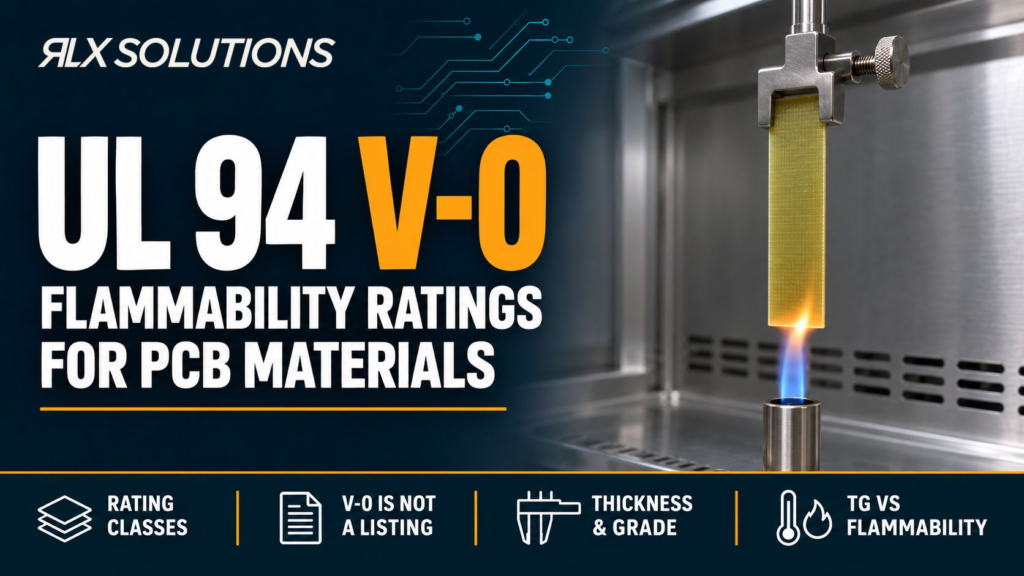
UL 94 is a flammability standard used to classify how polymeric materials behave in defined small-scale fire tests. For PCB work, V-0 is a vertical classification with more restrictive criteria than V-1 and V-2, while HB is a separate horizontal classification; none of these ratings certifies the finished circuit board or end product.
RLX Solutions, a contract electronics manufacturer based in Concord (Vaughan), Ontario, fabricates bare boards to UL 94 laminate and stackup callouts, with an engineer-reviewed DFM check before fabrication, so the laminate grade, thickness and stackup on the drawing stay aligned.
UL 94 ratings used in PCB material selection
A flammability class describes how a tested material specimen behaves under a defined ignition method and orientation. It is a material-performance classification, not a general statement that a finished electronic product is fireproof, fire safe, or approved for every end use.
For PCB engineers, the practical distinction is between horizontal and vertical test families. HB evaluates a specimen in the horizontal orientation. V-0, V-1, and V-2 use a vertical orientation and evaluate self-extinguishing behaviour after the ignition source is removed. The vertical classifications also account for whether flaming particles ignite the indicator material below the specimen.
| Decision factor | V-0 | V-1 | V-2 | UL 94 HB |
|---|---|---|---|---|
| Test orientation | Vertical | Vertical | Vertical | Horizontal |
| Relative vertical severity | Most restrictive of these three vertical classes | Less restrictive than V-0 | Less restrictive than V-1 | Different horizontal method |
| Flaming particles igniting the indicator | Not permitted | Not permitted | Permitted | Not assessed by the same vertical criterion |
| Engineering use | Use where the product requirement calls for V-0 | Use where the product requirement allows V-1 | Use where the product requirement allows V-2 | Use where the product requirement calls for HB |
The table should not be read as a universal product-selection hierarchy. A product standard, certification file, or component condition can require a specific material class. The engineer’s job is to identify that requirement first, then make sure the exact material used in the board construction has suitable evidence for the intended thickness and use.
V-0 does not mean the PCB is UL Listed
A material can carry a V-0 classification without making the assembled product UL Listed. Those are different layers of evaluation.
UL Recognized Components are intended for use inside larger certified products under stated conditions of acceptability. A UL Listed end product, by contrast, has been evaluated as the finished item for its applicable requirements. That distinction matters because a laminate property is one input into a product safety evaluation, not a substitute for it.
For the certification terminology itself, the difference between UL Listed, Recognized, and cUL status is covered separately. Layout-side work is a different topic: spacing, material and documentation rules for UL-ready PCB layouts covers the design decisions that come before laminate selection.
This separation prevents a common documentation error. A fabrication drawing may correctly require a V-0 material, while the product file may still contain separate requirements for spacings, insulation systems, components, enclosure construction, markings, or other safety controls. Passing one material test does not close those other items.
Thickness, colour, and exact material grade control the evidence
A flammability rating is tied to the material that was actually evaluated. UL Yellow Card information can include material grade, colour coverage, minimum tested thickness or thickness range, and the resulting flame class. Procurement therefore needs more than a generic material-family label when the rating is a controlled requirement.
A purchasing note that says “UL 94 V0” or “UL 94V-0” without the material grade and thickness can still leave an approval gap. If the chosen laminate is used outside the thickness covered by its recognition, the engineer should not assume the same classification carries over. Where colour is part of the recognition, an uncontrolled colour change can also matter.
Consider a hypothetical four-layer board released at 1.6 mm finished thickness. Assume the selected material documentation shows V-0 at the construction thickness being used. A later mechanical revision reduces the board to 0.4 mm while keeping the same laminate family name.
The second board should not inherit the first board’s evidence by assumption. The material record needs to support the thinner construction. The circuit, copper artwork, and layer count could stay identical while the compliance evidence changes because the material is now being used in a different thickness condition.
The same discipline applies to substitutions. A supplier may propose another FR-4 grade that processes well and meets the electrical drawing. That does not make the replacement equivalent for a controlled flammability requirement. The approved material list or engineering change process should verify the exact substitute before release.
Flammability is separate from Tg, dielectric loss, and CTI
Flame class answers one material question. It does not replace glass transition temperature, dielectric properties, comparative tracking index, moisture behaviour, or other characteristics that may govern a printed circuit board.
Glass transition temperature, or Tg, describes the temperature region where a laminate resin changes from a relatively rigid state to a more compliant state. A higher Tg does not automatically mean a higher flame class. The separate guide on how Tg ratings affect FR-4 material selection covers the thermal side of that decision.
Radio-frequency designs create another split. Dielectric constant and dissipation factor affect transmission-line behaviour and loss, while the flammability classification addresses response to the specified ignition test. The comparison of Rogers and FR-4 for RF material selection covers those electrical trade-offs in more detail.
Take a hypothetical pair of eight-layer, 1.6 mm boards. Material A is a 170°C Tg FR-4 grade with V-0 documentation at the intended thickness. Material B is a low-loss RF grade with its own V-0 documentation at the same intended thickness. Both meet the same flammability callout, but they are not interchangeable because their thermal and electrical properties serve different design needs.
This is why a compliance note should not collapse several material requirements into one phrase. If the design depends on Tg, controlled impedance, dielectric behaviour, tracking resistance, and flame class, each controlled property belongs in the engineering package.
Treat the flammability callout as a procurement-controlled requirement
The best place to control the requirement is in the released engineering documentation, not in an email sent after a substitute has already been selected. Procurement can then source against an approved definition instead of interpreting what “FR-4” was intended to mean.
A useful control set can include:
- exact laminate grade when the design is qualified around a specific material;
- required flammability class where the product or component file calls for one;
- finished board thickness and stackup information that affect material selection;
- approved-equivalent language only where engineering has defined what counts as equivalent;
- supplier documentation needed to verify the material recognition;
- revision control so an approved substitution remains traceable to the build record.
This approach also reduces false equivalence during sourcing. Two laminates may both satisfy the flame-class requirement but differ in Tg, dielectric properties, copper bonding behaviour, or process conditions. Conversely, two laminates may look electrically similar while carrying different recognition details.
For procurement, the decision rule is simple: treat the flammability class as one controlled attribute in the material specification. Do not use it as a shorthand for every other laminate property, and do not let another property stand in for it.
Same V-0 requirement can create different fabrication paths
The flame class itself does not tell you how difficult a PCB is to fabricate. Stackup architecture, via structure, material combinations, and registration demands can make two boards with the same compliance requirement very different manufacturing jobs.
Consider two hypothetical ten-layer, 1.6 mm boards. Assume both require materials documented for the same V-0 condition at their intended use thickness.
Board A uses one FR-4 material system and conventional plated through-holes from Layer 1 to Layer 10. Its multilayer structure can follow a conventional lamination and drilling sequence.
Board B uses a hybrid dielectric construction around RF-sensitive layers. It also has Layer 1 to Layer 2 microvias, Layer 2 to Layer 3 microvias, and a Layer 3 to Layer 8 buried-via structure. If via-in-pad is used under a dense package, the pad structure can add filling, copper capping, and planarization.
Both boards can carry the same material flammability requirement, yet Board B has more manufacturing stages and more interfaces that need material and process control. Its added fabrication effort comes from the hybrid stackup, sequential lamination, laser drilling, buried-via formation, and any fill-and-cap work, not from the V-0 label by itself.
This is also where substitution review becomes more sensitive. Replacing one dielectric in Board A may be a relatively contained material change. Replacing a dielectric in Board B can also affect impedance geometry, bonding behaviour, lamination conditions, and the construction evidence tied to the finished stackup.
Product safety standards decide where the flammability class matters
A material test does not tell an engineer which class every product must use. That requirement comes from the applicable end-product standard, certification program, component recognition, and conditions of acceptability for the intended use.
For industrial control equipment, UL 508A requirements for industrial control panels belong to the panel-level evaluation. A PCB used inside that equipment may still have material requirements, but those requirements sit inside a larger set of construction and safety controls.
The sequence should therefore start with the product requirement. Identify the applicable standard and certification path, then determine what it demands from the circuit board, laminate, components, spacing, and documentation. After that, the PCB material callout can be written to support the actual product file instead of applying a familiar flame class without context.
This approach is especially useful during redesigns. If an enclosure, board thickness, material family, or component recognition changes, the engineering team can check whether the original compliance basis still applies instead of assuming that an unchanged schematic means an unchanged safety file.
Put the requirement into the fabrication package
The fabricator needs enough information to connect the flammability requirement to the actual board construction. A note such as “FR-4” may be sufficient for an unconstrained prototype, but it is weak documentation when a specific material classification is part of the product’s compliance basis.
A controlled release can include:
- Material callout. State the exact approved laminate grade or the controlled performance requirement, depending on how the product is qualified.
- Stackup. Identify the copper and dielectric sequence, finished thickness, and any hybrid material interfaces.
- Flammability requirement. State the required class where it is part of the approved design basis.
- Substitution rule. Require engineering approval before a material change that could affect compliance or electrical behaviour.
- Supporting fabrication files. Provide Gerber RS-274X, ODB++, or IPC-2581 data with NC drill information as applicable.
- Supporting notes. Include the stackup PDF, fabrication notes, and impedance targets where those properties are controlled.
If the PCB uses controlled impedance, a laminate substitution can change dielectric geometry or electrical behaviour even when the substitute carries the same flame class. If the board uses a high-Tg material, replacing it with another V-0 laminate can also change the thermal design basis. The fabrication package should make those independent requirements visible rather than forcing one label to carry several meanings.
Send Your Fabrication Files
Send your Gerbers or ODB++, drill files and fabrication drawing. Every board gets an engineer-reviewed DFM check before fabrication starts, under an ISO 9001:2015 certified quality system. Request a quote or send your files to sales@rlxsolutions.com.
Frequently Asked Questions
Is V-0 better than HB for PCB materials?
V-0 and HB come from different test methods, so “better” is not the right design rule. V-0 uses a vertical method with stricter self-extinguishing criteria than V-1 and V-2, while HB uses a horizontal method. The applicable product standard or certification file should define the required class. Selecting a more restrictive class does not replace the need to verify the exact material, thickness, and other controlled properties in the PCB construction.
Does FR-4 automatically mean a V-0 PCB material?
Do not treat a generic FR-4 callout as complete evidence for a specific flammability requirement. FR-4 identifies a laminate family, while the compliance record needs to match the actual material grade and applicable use conditions. If the product file requires V-0, control that requirement explicitly and verify the selected laminate documentation rather than relying on the family name alone.
Can procurement substitute another V-0 laminate without engineering review?
A matching flame class does not prove that two laminates are equivalent. The substitute can differ in Tg, dielectric behaviour, thickness coverage, colour recognition, processing, or other properties tied to the design. Procurement should use the approved-equivalent rules in the released documentation and route any unlisted substitute through engineering review before it becomes part of the controlled build.
Does V-0 material make the finished electronic product UL Listed?
No. A material flammability classification and a finished-product Listing are different forms of evaluation. Recognized materials or components can support an end-product certification program, but the complete product is evaluated against its applicable requirements. Board material selection is therefore one part of the safety file, alongside the other construction, component, spacing, and documentation requirements that apply.
What should a buyer request for a PCB with a controlled flame class?
Request the approved laminate grade or defined equivalent criteria, the required flame class, the intended board thickness and stackup, and the supporting material recognition record. The release package should also state how substitutions are approved and traced. This gives purchasing and fabrication teams a controlled requirement rather than a generic material note that can be interpreted differently by each supplier.