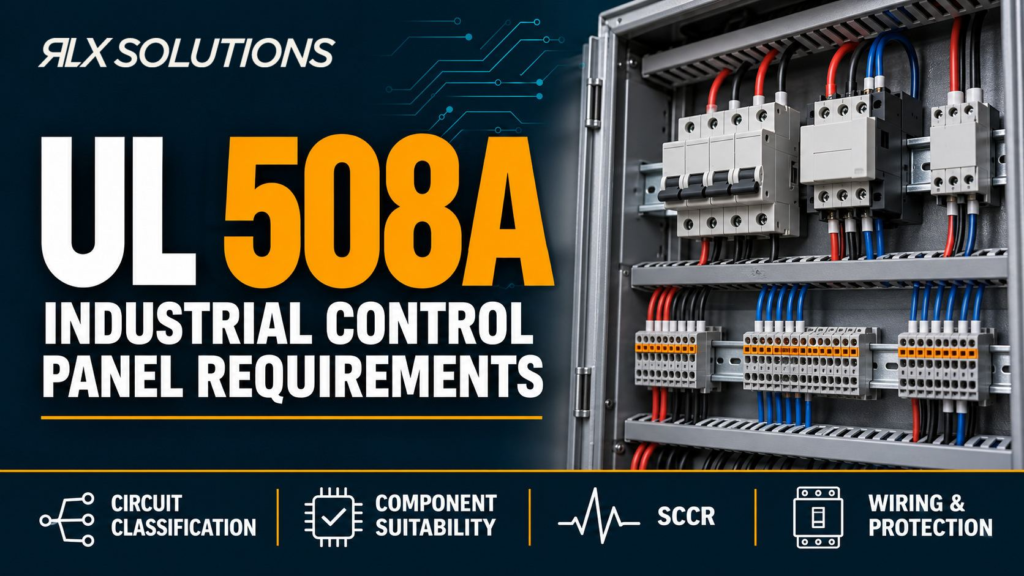
UL 508A is the active UL standard for industrial control panels. It addresses component suitability, power and control circuits, protection, wiring, enclosures, short-circuit current rating (SCCR), and required markings. A compliant design treats these requirements as one coordinated system rather than a final inspection checklist.
RLX Solutions, a contract electronics manufacturer based in Concord (Vaughan), Ontario, provides compliance-focused engineering for UL 508A control panel electronics, covering schematic, PCB layout, thermal and EMI pre-compliance review. RLX has UL 508A design experience.
Scope of the Industrial Control Panel Standard
An industrial control panel is an assembly that combines power-circuit components, control-circuit components, or both, inside an open or enclosed construction. Typical elements include disconnecting means, overcurrent protection, contactors, motor controllers, power supplies, relays, terminal blocks, programmable controllers, drives, and operator-interface connections.
The standard governs how those parts are selected and used together so the finished assembly can be evaluated as a system. That is broader than checking whether individual parts carry a UL mark. A component can be suitable in one application and unsuitable in another because its conditions of acceptability, circuit function, rating, enclosure use, protection, or installation method may differ.
For engineers, that changes the design sequence. The panel architecture should be developed with the intended certification path in mind from the first schematic revision. For procurement teams, the key issue is approved substitution. Replacing a device with a similar-looking part can affect the certification basis if its category, ratings, protection requirements, or intended use differ.
UL lists the standard as active and revises it periodically, and it publishes effective-date notices separately, so engineers should work from the current revision and current component guidance rather than relying on an old internal checklist.
UL 508A Panel Design Starts With Circuit Classification
The first practical design task is separating power circuits from control circuits and identifying how energy enters, is protected, is switched, and reaches each load. That classification affects conductor selection, protective-device logic, disconnecting means, component application, and spacing decisions.
A useful schematic review should identify:
- Incoming supply circuits and every source of energy entering the enclosure.
- Branch circuits feeding motors, heaters, drives, transformers, or other loads.
- Control circuits derived from power supplies or transformers.
- Protective devices and the components they are intended to protect.
- Disconnecting means and what each disconnect actually de-energizes.
- Grounding and bonding paths.
- Field terminals and external circuits that cross the enclosure boundary.
This is where a design can become difficult to certify even though every symbol on the schematic appears reasonable. A branch device may be applied outside its intended role. A control transformer may be protected in a way that does not match its application. A field terminal may expose a circuit classification that was never resolved in the original design.
For PCB-level isolation inside panel electronics, the guide to creepage and clearance spacing on circuit boards covers how surface paths, air gaps, slots, conductive hardware, and assembled geometry affect electrical spacing.
Component Selection Is About Suitability, Not Logo Matching
UL Listed and UL Recognized components do not mean the same thing, and neither marking should be treated as universal permission to place the part anywhere in a panel. The engineering question is whether the component is acceptable for its exact function and installation conditions.
The component rules address how devices may be used in the assembly. The designer must look beyond the front-page electrical rating and consider the component category, intended use, required protective devices, enclosure conditions, terminal limitations, and any conditions attached to recognition.
For procurement, substitutions need engineering review before purchase approval. A different contactor, breaker, terminal block, power supply, or drive may have the same nominal operating rating yet require different protection or installation treatment.
The distinction between Listing and Recognition is covered in the explainer on UL Listed, Recognized and cUL marks, which explains how certification marks apply differently to complete products and components.
Hypothetical example: same function, different certification effect
Consider two proposed motor-control branches in a hypothetical panel. Both use a 10 hp motor, a contactor, an overload device, and branch protection. Option A uses a component set already selected for the intended branch arrangement. Option B swaps the contactor for a mechanically compatible alternative with the same coil voltage and similar current rating.
Electrically, both may appear equivalent during a basic schematic review. From the standard’s standpoint, Option B still needs a component-use review. If its acceptable application, short-circuit combination, terminal conditions, or required protective device differs, the substitution can force a branch redesign. Procurement therefore needs a controlled substitution process tied to the certification file, not a visual or nominal-rating match.
Short-Circuit Current Rating Drives the Power-Circuit Architecture
Short-circuit current rating, usually written as SCCR, is the amount of prospective short-circuit current an assembly can withstand under specified conditions. For an industrial control panel, SCCR is a design input and a required marking consideration, not an afterthought added after the enclosure is built.
Supplement SB provides a recognized method for determining panel SCCR. The practical design problem is that the panel rating can be constrained by the weakest relevant component or combination in the power circuit unless an accepted combination rating or other permitted method supports a higher result.
That is why SCCR should be reviewed before the bill of materials is frozen. If a low-rated device appears deep in the branch architecture, replacing it later can trigger changes to protective devices, branch layout, component families, or available combinations.
Panel A vs Panel B: same loads, different SCCR path
| Decision factor | Panel A | Panel B |
|---|---|---|
| Motor branches | Three 5 hp branches | Three 5 hp branches |
| Main architecture | Common feeder with coordinated branch components | Common feeder with one substituted branch device |
| Control power | 24 VDC supply | 24 VDC supply |
| Branch review | Component combinations reviewed as a set | One branch contains an alternative device |
| Engineering effect | SCCR path remains consistent with the selected architecture | Alternative device can become the limiting point or require a new combination review |
| Procurement effect | Controlled part list supports repeat builds | Substitution needs engineering approval before release |
The point is not that one brand or device type is automatically better. The deciding factor is whether the selected components support the intended SCCR method as an assembly. A late substitution can change the rating logic even when the machine still functions normally.
For buyers, this is a strong reason to separate functional equivalence from compliance equivalence. The first asks whether the machine runs. The second asks whether the panel still satisfies the documented certification basis.
Wiring, Protection, and Disconnects Must Be Designed as One System
Wire size, terminal suitability, overcurrent protection, disconnecting means, and branch architecture interact. Treating them as separate drafting tasks creates avoidable review problems.
A designer should trace each power path from the incoming terminals through the disconnect, branch protection, control device, load terminals, and grounding system. That path should show which device protects which conductor and component, which circuits remain energized under each disconnect condition, and how field wiring is identified.
Common engineering review points include:
- Incoming supply identification and source assumptions.
- Main and branch protective devices.
- Motor branch arrangement.
- Transformer and power-supply protection.
- Conductor termination ratings and terminal use.
- Internal wire routing and separation.
- Grounding and bonding.
- Multiple-source warnings where more than one energy source exists.
- Field-wiring terminal identification.
- Disconnect functions and service conditions.
A panel can pass a functional test and still have a certification problem if the protective architecture does not match the components being protected. Functional testing proves operation. Compliance review checks whether the construction and protection scheme meet the applicable safety requirements.
Enclosure Selection Includes Environment, Openings, and Internal Heat
The enclosure is part of the certified construction. It is not just a box around otherwise compliant components.
The design needs an enclosure suitable for the intended environment and the component arrangement inside it. Openings, ventilation, operator devices, cable entries, door-mounted hardware, bonding, and internal heat sources all affect the finished construction.
Thermal behaviour matters because control assemblies often place drives, power supplies, transformers, contactors, and other heat-producing devices in confined space. A layout that is electrically correct can still create a poor equipment environment if heat is concentrated around temperature-sensitive components or if airflow paths are blocked.
A useful enclosure review should check component spacing, wire-bend space, service access, heat distribution, ventilation strategy, field-entry zones, and whether the chosen enclosure construction matches the intended installation.
For assemblies that include custom or embedded circuit boards, the overview of building boards for industrial equipment covers how board design, fabrication, assembly, inspection, and production controls connect across an industrial electronics build.
Markings and Documentation Are Part of the Finished Assembly
The finished assembly needs the correct ratings, identification, warnings, and documentation to support installation and inspection. These items belong in the engineering package, not in a paperwork exercise after wiring is complete.
The nameplate and related markings communicate the information an installer or authority having jurisdiction needs to evaluate the panel in its intended electrical system. Depending on the construction, that can include supply information, SCCR, enclosure information, identification of the responsible manufacturer, wiring references, and warnings tied to multiple sources or special conditions.
Documentation should be built alongside the design. Waiting until the physical assembly is complete often exposes missing source data, inconsistent device ratings, or assumptions that were never captured on the schematic.
A practical documentation package should keep these items synchronized:
- Approved schematic and wiring diagrams.
- Bill of materials with controlled manufacturer part numbers.
- Component certification information and application notes where relevant.
- SCCR determination records.
- Panel ratings and nameplate data.
- Enclosure and environmental designation.
- Field-wiring information.
- Revision history and approved substitutions.
- Inspection and test records required by the certification process.
The benefit is traceability. If a device changes later, engineering can identify which rating, marking, protection pairing, or certification record needs review.
The Panel Standard Is Different From UL 508 and Product-Level Certification
The panel standard applies to control assemblies. UL 508 historically covered industrial control equipment, meaning devices such as controllers and related control components rather than the complete panel construction. Other end products may also be governed by separate product standards even when they contain a certified control enclosure.
This distinction matters in machine and equipment programs. A certified panel does not automatically certify the entire machine, process skid, laboratory system, or end product that contains it. The panel may be one evaluated subsystem inside a larger certification scope.
Likewise, using UL Listed or Recognized components does not automatically make the finished assembly certified. Certification depends on the complete construction, permitted component use, protection, wiring, enclosure, SCCR, markings, and the applicable certification process.
For PCB material flammability terminology, the guide to laminate flame classes such as V-0 covers how UL 94 classifications relate to polymer flammability and why that rating should not be confused with a complete product certification.
Design for Compliance Before the Schematic Is Frozen
The easiest time to solve a compliance conflict is before component placement, panel layout, and procurement commitments become fixed. Compliance-driven design should therefore run in parallel with functional design.
A practical sequence is:
- Define the intended market, installation environment, and certification target.
- Establish the incoming power architecture and circuit classifications.
- Select protective devices and branch components as coordinated groups.
- Review component suitability and conditions of acceptability.
- Establish the SCCR method before releasing the controlled bill of materials.
- Define disconnecting, grounding, bonding, and field-wiring architecture.
- Select the enclosure and review thermal and physical layout.
- Prepare required markings, wiring references, and certification documentation.
- Lock substitutions behind engineering approval.
- Run a final design review before the panel build is released.
Hypothetical example: compliance review before layout release
Assume a hypothetical control panel uses a 480 VAC incoming supply, two 7.5 hp motor branches, one variable-frequency drive, a 24 VDC control supply, and a PLC. The initial schematic is functionally complete, but the panel layout has not been released.
A compliance-focused review at this point can still change the branch protection, disconnect arrangement, component combinations, terminal plan, field-wiring zones, SCCR method, and enclosure layout without requiring a physical rebuild. If the same review occurs after panel wiring is complete, each correction can affect drawings, purchased components, labels, wire routing, and inspection records.
The engineering lesson is simple: compliance requirements belong in architecture review, not just final inspection.
Inputs that make a compliance review useful
A useful review starts with enough information to understand both the electrical design and the intended certification path. Sending only a PDF schematic can leave important enclosure, component, and installation assumptions unresolved.
Provide, where available:
- Electrical schematics and control diagrams.
- Current bill of materials with manufacturer part numbers.
- Intended supply characteristics and load list.
- Motor, drive, transformer, and power-supply details.
- Proposed enclosure and environmental requirement.
- Panel layout or mechanical drawing.
- Intended market and certification target.
- Existing SCCR work, if already developed.
- Field-wiring and terminal information.
- Any required product-level standard that sits above the panel.
- Existing component substitutions that need approval.
For embedded electronics, include the native design files, PCB fabrication files, BOM, and assembly information relevant to the engineering scope.
Tell Us What You’re Building
Send requirements, a reference design or a schematic in progress. RLX engineers will scope the engagement and come back with a proposal: fixed scope, T&M or turnkey. Request a quote or send your files to sales@rlxsolutions.com.
Frequently Asked Questions
Is UL certification required for every control panel?
No. Whether a panel must be UL certified depends on the project specification, installation requirements, authority having jurisdiction, end-product certification path, and customer requirements. The standard is widely used for industrial control-panel construction in North America, but the certification requirement for a specific project should be confirmed from the applicable code and contract requirements.
What is the difference between a UL 508A panel and a panel built with UL components?
A panel built with UL Listed or Recognized components is not automatically certified as a complete assembly. The construction must address component application, protection, wiring, SCCR, enclosure construction, markings, and other applicable requirements. Component certification supports the design, but it does not replace evaluation of how those components are used together.
What does SCCR mean on a control panel?
SCCR means short-circuit current rating. It indicates the short-circuit current level the panel is evaluated to withstand under specified conditions. The rating is tied to the power-circuit architecture and component combinations, so it should be established during design rather than treated as a label chosen after the enclosure is assembled.
Can a component be substituted after the design is complete?
Possibly, but the substitution should be reviewed before approval. A replacement with similar electrical ratings may have different certification status, protective-device requirements, terminal conditions, or short-circuit combinations. The engineering review should confirm whether the change affects SCCR, branch protection, markings, documentation, or another part of the certification basis.
Does UL 508A certification cover the entire machine?
No. The certification covers the industrial control panel assembly. A machine or larger end product can be subject to additional standards and certification requirements beyond the panel itself. The panel certification may form part of the larger evaluation, but it does not automatically certify the full machine, skid, test system, or other end equipment.