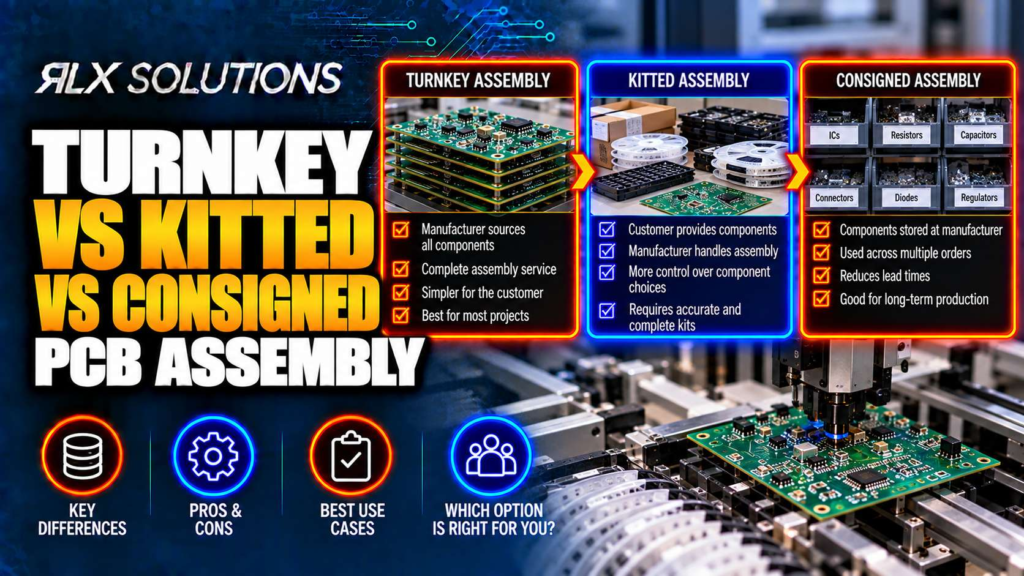
Turnkey, kitted and consigned PCB assembly differ mainly in who buys and supplies the components. Turnkey puts procurement with the manufacturer, kitted splits sourcing between buyer and manufacturer, and consigned puts the complete component kit with the customer. RLX Solutions, a contract electronics manufacturer in Concord, Ontario, supports all three models.
The assembly process may look similar once components reach the line, but the commercial and operational consequences are different. Your choice changes who owns purchasing work, shortage resolution, component authenticity evidence, inventory coordination and the risk of discovering a kit problem when production is supposed to start. For the full picture, see our PCB Assembly Guide.
The Practical Difference Is Component Ownership Before Assembly
The fastest way to separate the three models is to ask one question: who is responsible for getting each required component to the assembly operation?
| Decision Factor | Turnkey | Kitted | Consigned |
|---|---|---|---|
| Component procurement | Manufacturer procures all components | Customer supplies selected parts; manufacturer sources the balance | Customer supplies the complete kit |
| Bare PCB | Manufacturer fabricates or sources it | Defined as part of the build scope | Defined as part of the build scope |
| Customer purchasing workload | Lowest of the three | Shared | Highest of the three |
| Control of critical inventory | Manufacturer manages sourcing | Customer can retain control of selected parts | Customer controls the full component kit |
| Shortage coordination | Primarily manufacturer-side | Split between both parties | Primarily customer-side |
| Best fit | Outsourced procurement and assembly | Critical or long-lead customer-held parts | Existing complete inventory or mandated supply |
A turnkey PCB assembly transfers component procurement to the contract manufacturer along with assembly. A kitted build, sometimes called partial turnkey, divides procurement responsibility by line item. A consigned PCB assembly starts with a complete customer-supplied kit.
That distinction matters because assembly cannot consume a purchase order. It consumes physical parts in the correct quantities, packages and condition. A component that exists in your enterprise resource planning system but has not reached the manufacturer is still a production constraint.
Turnkey PCB Assembly Consolidates Procurement and Production Responsibility
In a turnkey build, the manufacturer procures the components, fabricates or sources the bare printed circuit boards, assembles them, tests the finished boards and ships the order.
This reduces the number of material transactions your procurement team has to manage. Instead of placing and tracking purchase orders across a bill of materials (BOM), you provide the manufacturing package and manage the build through the contract manufacturer.
The deeper advantage is coordination. A BOM problem discovered during sourcing can be handled before it becomes a line-side shortage. Procurement decisions and assembly requirements sit closer together.
Consider a hypothetical 10-layer board with a 0.5 mm-pitch BGA, 0402 passives and 1.6 mm finished board thickness. If one specified component becomes difficult to source, the issue needs to be resolved against the approved BOM before placement begins. Under turnkey, that sourcing activity sits within the manufacturer’s procurement scope rather than being divided across two organisations.
That does not mean purchasing should become a black box. Traceability matters, especially when authorized distribution cannot satisfy the requirement.
Component sourcing can involve authorized distributors, excess inventory, specialised trading networks and customer inventory. As sourcing moves away from straightforward authorized channels, authenticity controls become more significant. Packaging and date-code checks, visual inspection, lot verification, X-ray, electrical testing and, where required, third-party analysis can form part of counterfeit-risk control.
If authenticity cannot be established, the correct procurement decision is not to push the part onto the assembly line.
Kitted Assembly Protects Control of the Parts That Matter Most
Kitted assembly divides the BOM deliberately. You supply selected critical or long-lead components, while the manufacturer procures the remainder.
This model is useful when the OEM has an inventory position that would be wasteful to abandon but does not want to manage every resistor, capacitor, connector and commodity component required by the build.
Suppose an 8-layer control board contains 126 BOM line items. The customer already holds the microcontroller, an allocated power device and a programmed memory component. Those three lines can be supplied to the manufacturer while the remaining 123 lines are sourced as part of the assembly programme.
The important engineering issue is not the percentage of the BOM that is customer-supplied. It is the interface between the two sourcing responsibilities.
A single missing customer-supplied device can stop a build even when every manufacturer-sourced line is ready. Part numbers, approved substitutions, quantities and shipment status therefore need to be unambiguous before material is committed to production.
Kitting can also protect programme-specific inventory. If a component has already been purchased against a product forecast, supplying it into a partial-turnkey build lets the OEM consume that stock without taking on procurement of the entire BOM.
Consigned PCB Assembly Gives the Customer Maximum Material Control
With consigned assembly, the customer sends the complete component kit and the manufacturer performs assembly, inspection and test.
This is fundamentally different from sending a handful of strategic components. The customer now owns the material-readiness problem across the BOM.
Imagine a 6-layer, 1.6 mm circuit board with 85 BOM lines, a 0.8 mm-pitch BGA and mixed surface-mount and through-hole components. If 84 lines arrive correctly but the mating connector is absent, the kit is incomplete. Whether that missing item blocks all work or a later operation depends on the assembly sequence, but the material discrepancy still has to be resolved.
Consignment therefore works best when the customer has a reason to control the entire component supply. Existing inventory, customer-specific material controls or an established procurement programme can provide that reason.
The hidden workload is kit integrity. Part identity, quantity, packaging, moisture-sensitive device handling and lot information have to survive the handoff from the customer’s stockroom to the manufacturer’s receiving process.
Consigned does not mean uninspected. Customer ownership of a component does not remove the need for incoming control or appropriate handling before assembly.
Same Board, Different Sourcing Model: Board A vs Board B
Two identical circuit boards can carry different programme risk solely because of how their material is supplied.
Assume both designs are 12-layer boards, 1.6 mm thick, with a 0.4 mm-pitch BGA, 0201 passives and the same fabrication and assembly data.
| Decision Factor | Board A: Turnkey | Board B: Consigned |
|---|---|---|
| Layer count | 12 | 12 |
| Board thickness | 1.6 mm | 1.6 mm |
| BGA pitch | 0.4 mm | 0.4 mm |
| Assembly design | Identical | Identical |
| Component purchasing | Manufacturer | Customer |
| Complete-kit responsibility | Manufacturer | Customer |
| Customer inventory coordination | Lower | Higher |
| Primary pre-build dependency | Manufacturer sourcing completion | Complete customer kit arrival |
Nothing about the placement geometry makes Board B inherently harder to solder. The difference occurs upstream.
For Board A, procurement status can be coordinated with the planned build as part of the manufacturer’s sourcing scope. For Board B, production readiness depends on the customer getting the entire physical kit to receiving with the required material information intact.
That is why comparing turnkey and consigned quotations only by the assembly line item misses part of the decision. The two models assign procurement work and material risk differently.
Do Not Choose the Sourcing Model on Piece Price Alone
The lowest component price is not automatically the lowest programme cost.
Turnkey pricing includes procurement activity that a consigned quotation does not need to carry in the same way. Consignment can therefore appear attractive if you compare only the manufacturer’s quoted scope while ignoring the purchasing, receiving, inventory and logistics work retained inside your own organisation.
The useful comparison is total responsibility.
For a hypothetical 500-board build with 100 BOM lines, a consigned programme can require the customer to maintain availability across 50,000 board-level component requirements before considering placement quantities greater than one per board. Turnkey transfers that purchasing coordination into the manufacturing programme. Kitted assembly lets you choose which portion remains internal.
The same logic applies to shortage risk. A low-cost component that arrives after every other item can determine the material-ready date for the build.
Inspection and Test Should Not Change Because You Supplied the Parts
Sourcing model and workmanship requirement solve different problems. Choosing consigned instead of turnkey should not mean choosing a different assembly quality target.
For PCB assembly, solder paste inspection (SPI) checks paste before reflow. Automated optical inspection (AOI) examines the board after reflow, while automated X-ray inspection (AXI) provides visibility into hidden joints such as BGAs, land grid arrays and quad-flat no-lead packages.
Electrical testing addresses another failure class. Flying-probe in-circuit test can provide net coverage without a dedicated fixture for prototype and low-volume work. Bed-of-nails in-circuit testing uses a fixture for production builds. Functional testing can then exercise the product against a customer-defined test specification and record pass/fail results with serial traceability.
A first article adds a release gate. On a new build, the initial assembly can be inspected and customer-approved before the production lot proceeds.
The implication is important: turnkey, kitted and consigned describe material responsibility, not inspection depth. The workmanship class, inspection plan, electrical test and functional test requirements should come from the product and programme requirements.
Moisture-Sensitive and Traceable Parts Need Control Across the Handoff
Customer-supplied material introduces an interface that does not exist in quite the same form when sourcing and assembly are under one manufacturing programme.
Moisture-sensitive device (MSD) handling is one example. Packaging condition and controlled storage matter because exposure before reflow can affect package reliability. If the customer supplies the component, its condition at handoff matters just as much as its part number.
Traceability creates a similar issue. Date codes, lot codes and material records need to remain associated with the build where the programme requires that history.
This becomes especially relevant with consigned material. A complete kit is more than a box containing the correct nominal quantity. The receiving side needs enough information to identify and control what has arrived.
Your Files Should Make the Sourcing Boundary Explicit
A manufacturer should not have to infer which BOM lines are customer-supplied.
For PCB assembly, the manufacturing package should identify the BOM, pick-and-place or centroid data and assembly drawing alongside the board manufacturing data. Gerber RS-274X, ODB++, IPC-2581 and NC drill are accepted manufacturing formats, while the BOM can be supplied as an XLSX or CSV file.
For a kitted build, mark customer-supplied lines clearly in the BOM. If a component has approved alternates, communicate that approval explicitly rather than expecting procurement to infer interchangeability from package or electrical similarity.
For a consigned build, reconcile the complete kit against the BOM before shipment. The earlier a discrepancy is visible, the less likely it is to surface when material is being prepared for production.
An engineer-reviewed design for manufacturability (DFM) and design for assembly (DFA) review can catch board and assembly issues, but it cannot turn an unidentified missing component into available inventory.
Choose by the Responsibility You Actually Want to Retain
The decision becomes clearer when you start with your internal constraint rather than with the three service labels.
- Choose turnkey when you want the contract manufacturer to own component procurement along with fabrication or bare-board sourcing, assembly and test.
- Choose kitted assembly when a small group of parts should remain under your control. Long-lead devices, critical components or inventory you already own can stay customer-supplied while the rest of the BOM moves into the manufacturer’s procurement scope.
- Choose consigned assembly when you intentionally want to retain control of the complete component kit and already have the systems and inventory to support that decision.
There is no requirement to keep the same model forever. A prototype assembled from engineering inventory can use consigned material, while a later build can move selected purchasing responsibility into a kitted or turnkey structure. What matters is defining the boundary clearly for each build.
Get the Sourcing Boundary Settled Before the Quote
If you are preparing a new printed circuit board build, RLX reviews DFM and DFA as part of every quote. Send the Gerbers or other manufacturing data, BOM, pick-and-place file and assembly drawing, and identify which components, if any, you intend to supply. Complete files allow sourcing responsibility to be established before the build is released.
Frequently Asked Questions
Is turnkey PCB assembly the same as full-service PCB assembly?
Turnkey PCB assembly means the manufacturer handles component procurement, fabricates or sources the bare PCBs, then builds, tests and ships the finished boards. The useful distinction is procurement responsibility. Confirm the quoted scope rather than relying on terminology alone, because the manufacturing package and test requirements still need to define what the finished assembly must receive.
Can I supply only the microcontroller or other long-lead components?
Yes. That is a kitted or partial-turnkey model. You can supply critical or long-lead components while the remaining parts are sourced for the build. Identify customer-supplied lines clearly in the BOM and coordinate their availability with the planned assembly so one missing supplied item does not become a production constraint.
Are customer-supplied components inspected before assembly?
Incoming component control still matters for customer-supplied material. Relevant controls can include packaging inspection, date-code and country-of-origin checks, visual inspection and lot verification. Moisture-sensitive devices also require appropriate handling and storage. The exact controls should match the material, sourcing history and programme requirements rather than being relaxed simply because the customer supplied the parts.
Does consigned assembly reduce the inspection performed on the finished board?
No. The sourcing model is separate from assembly workmanship and inspection. PCB assemblies can be built to IPC-A-610 Class 2 or Class 3 requirements, with processes including pre-reflow SPI, post-reflow AOI, X-ray for hidden joints and manual visual inspection. Electrical and functional testing can then be applied according to the build requirements.
What files are needed to quote a PCB assembly?
A PCB assembly package should include the BOM, pick-and-place or centroid data and assembly drawing, plus the manufacturing files needed for the bare PCB. Accepted manufacturing formats include Gerber RS-274X, ODB++, IPC-2581 and NC drill. For kitted or consigned work, the documentation should also make customer-supplied material clear.